University of Missouri–Kansas City School of Medicine
 | |
Other name | UMKC-SOM |
|---|---|
| Type | Medical school |
| Established | June 28, 1971 [1] |
Parent institution | University of Missouri–Kansas City |
| Accreditation | LCME |
| Affiliation | University of Missouri System |
| Dean | Alexander Norbash[2] |
Total staff | 885 (2025)[3] |
| Students | 868 (Fall 2024)[4] |
| Undergraduates | 226 (Fall 2024)[5] |
| Postgraduates | 128 (Fall 2024)[6] |
Doctoral students | 514 (Fall 2024)[7] |
| Location | Kansas City , Missouri , United States |
| Campus | Urban |
| Other Campuses | St. Joseph, Missouri |
| Colors | Blue and gold[8] |
| Website | www |
The University of Missouri–Kansas City School of Medicine, established in 1971,[9] is one of three medical schools located near downtown Kansas City and only one of two public medical schools in the state of Missouri.[10] The school offers a traditional four-year M.D. program as well as an accelerated combined B.A./M.D. program based on a six-year curriculum. The school of medicine admits students into the program directly from high school, and graduates are able to earn a baccalaureate and a Doctor of Medicine degree (B.A./M.D.) from UMKC.[11] The curriculum integrates the liberal arts, basic sciences, and clinical sciences with a team approach to learning. More than 4,000 physicians have graduated from the University of Missouri–Kansas City School of Medicine, with the majority being in the six-year combined degree program.[12]
Rankings
For 2025, U.S. News & World Report ranked the University of Missouri–Kansas City School of Medicine[13]:
- #35 in Most Graduates Practicing in Health Professional Shortage Areas
- #125 (tie) in Most Graduates Practicing in Primary Care
- #89 (tie) in Most Graduates Practicing in Rural Areas
Campuses
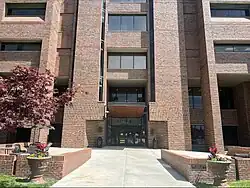
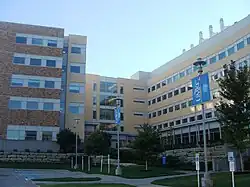
The University of Missouri–Kansas City School of Medicine operates two campuses. The Health Sciences District (HSD) campus is situated in the Hospital Hill neighborhood of Kansas City, Missouri, alongside the UMKC schools of Dentistry, Pharmacy, and Nursing. The campus is closely linked to the University Health Truman Medical Center hospital complex and Children's Mercy Hospital. The HSD campus is attended by six-year B.A./M.D. students and M.D.-Only students.[14][15]
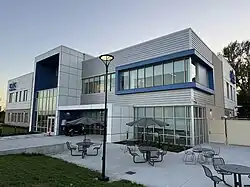
The St. Joseph campus of the UMKC School of Medicine is situated in St. Joseph, Missouri. Its M.D. program has long operated out of Mosaic Life Care hospital, where students engage in rural health training and clinical rotations across regional sites.[16]
In August 2025, UMKC officially opened a 22,000-square-foot medical education building on its own campus in St. Joseph. The building cost approximately $14.5 million, and includes classrooms, simulation labs, and exam spaces designed to support rural medicine education.[17]
Admissions
The entering class of 2023, which includes the B.A./M.D. and M.D.-Only students, had an average GPA of 3.85 and an MCAT score of 510. There were 1,895 applicants for 136 spots. There was a 5.99 percent interview invitation rate and an overall 7.18 percent acceptance rate.[18][19] It is important to note that the B.A./M.D. students are not required to take the MCAT, while the M.D.-Only applicants are.[20][21] B.A./M.D. applicants are required to take either the ACT or the SAT. The average admitted ACT and SAT scores are 32 and 1420, respectively.[22]
Additionally, for the 2023-2024 cycle, of the 1,895 applications, 18.2 percent were in-state, while 81.8 percent were out-of-state. Of the matriculants, 64.0 percent came from in-state, and 36.0 percent came from out-of-state applicants.[23]
Education
In addition to the six-year B.A./M.D. program, the School of Medicine offers a traditional four-year Doctor of Medicine (M.D.), Master of Science in Anesthesia, Master of Medical Science Physician Assistant, Master of Science in Bioinformatics, Master of Health Professions Education, Interdisciplinary Ph.D., and graduate certificates.[24]
Six-year B.A./M.D. and M.D.-Only students gain hands-on clinical experience immediately entering their respective programs through the docent system. Each student joins a "docent team" and follows a faculty physician or docent. In this educational environment, docents offer clinical instruction while mentoring students in their personal and professional growth.[25]
In addition to the docent system, medical students in both six-year B.A./M.D. (Year Two) or M.D.-Only (Year One) began the Human Structure Function series in January.[26] The Human Structure Function (HSF) series consists of integrated courses in anatomy, histology, embryology, physiology, and biochemistry of the various systems within the human body.[27] Students are projected to complete the HSF I-IV series by the end of the summer semester in B.A./M.D. Year Two or M.D.-Only Year One.[28]
Pre-clinical coursework at UMKC School of Medicine, including the HSF series, is one of eleven medical schools in the United States utilizing a letter grading scale.[29] The utility of GPA has become a controversial policy in medical education. It draws criticism from students and clinical faculty due to its negative impact on student well-being during pre-clinical coursework.[30]
Sojourner Health Clinic
UMKC-SOM runs a student-operated outpatient clinic called the Sojourner Health Clinic on Saturdays. It caters to the under-served adult population of Greater Kansas City, offering physical exams, prescription drugs, lab work, and various social services free of charge.[31] The clinic sees more than 800 visits from underserved and uninsured patients annually. The Sojourner Health Clinic partners with Linwood United Church, Lazarus Ministries, University Health Primary Care Bess Truman Family Medicine Center, UMKC School of Medicine, UMKC Physician Assistant Program, UMKC School of Dentistry, UMKC School of Pharmacy, and Rockhurst Occupational Therapy Program.[32]
Stuber Health Center
The Stuber Health Center, formerly the Social Welfare Board Clinic, is "The oldest free and charitable clinic in the United States." It has been in operation since 1913. It provides medical, dental, and specialty services such as reproductive health to the uninsured residents of St. Joseph, Missouri, and Buchanan County. The Stuber Health Center had 4,995 primary care and 3,572 dental visits in 2023.[33] It also provides a unique opportunity for medical students from UMKC-SOM to volunteer and make an elective in their curriculum.[34]
Hospital Affiliates
The UMKC School of Medicine maintains partnerships with several hospitals in both the Kansas City area and the St. Joseph region. Among its affiliates are:[35]
- Center for Behavioral Medicine
- Children's Mercy Hospital—Kansas City
- Kansas City VA Medical Center
- Research Medical Center
- Mosaic Life Care at St. Joseph—Medical Center
- Saint Luke's Hospital of Kansas City
- University Health Behavioral Health
- University Health Bess Truman Family Medicine Center
- University Health Lakewood Medical Center
- University Health Truman Medical Center
References
- ↑ "UM-System; President's Office; James C. Olson Papers; Speeches and Related Materials". University Archives, University of Missouri. Retrieved October 2, 2025.
- ↑ "UMKC Alumnus Named Dean of School of Medicine". Umkc.edu. Retrieved April 26, 2024.
- ↑ "Faculty/Staff Reports". Umkc.edu. Retrieved October 20, 2024.
- ↑ "Comprehensive Enrollment Reports" (PDF). Umkc.edu. Retrieved October 20, 2024.
- ↑ "Comprehensive Enrollment Reports" (PDF). Umkc.edu. Retrieved October 20, 2024.
- ↑ "Comprehensive Enrollment Reports" (PDF). Umkc.edu. Retrieved October 20, 2024.
- ↑ "Comprehensive Enrollment Reports" (PDF). Umkc.edu. Retrieved October 20, 2024.
- ↑ University of Missouri–Kansas City Visual Identity Guidelines (PDF). Retrieved August 23, 2022.
- ↑ Kanter, Steven L. (2015). "Advancing Health by Producing Leaders in Medicine". Missouri Medicine. 112 (3): 175–178. ISSN 0026-6620. PMC 6170118. PMID 26168585.
- ↑ "Medical Schools in Missouri". Medical School Headquarters. Retrieved 2024-05-07.
- ↑ "B.A. / M.D. Program". med.umkc.edu. Retrieved 2024-05-22.
- ↑ "2021 BA/MD Viewbook". www.umkc.edu. Retrieved 2024-05-22.
- ↑ "University of Missouri-Kansas City - Best Medical Schools". U.S. News & World Report. Retrieved 2025-09-29.
- ↑ "Campus Visit Options". med.umkc.edu. Retrieved 2024-05-29.
- ↑ "UMKC School of Medicine St. Joseph Campus". med.umkc.edu. Retrieved 2024-05-29.
- ↑ "UMKC's School of Medicine To Open New Campus in St. Joseph With a Focus on Rural Health Care – UM System Community Connect". Retrieved 2024-05-22.
- ↑ Marketing, Strategic; Communications. "UMKC Celebrates Grand Opening of New St. Joseph Medical School Building". www.umkc.edu. Retrieved 2025-09-29.
- ↑ "University of Missouri-Kansas City School of Medicine - MCAT, GPA, and TUITION". CollegeEvaluator. Retrieved 2024-06-11.
- ↑ "MU School of Medicine - Kansas City GPA, MCAT, and Acceptance Rate". medcmp. Retrieved 2024-06-11.
- ↑ "B.A. / M.D. Program FAQs | University of Missouri-Kansas City". med.umkc.edu. Retrieved 2024-06-10.
- ↑ "M.D. Program Admissions Requirements | University of Missouri-Kansas City". med.umkc.edu. Retrieved 2024-06-10.
- ↑ "B.A. / M.D. Program Admission Requirements & Eligibility | University of Missouri-Kansas City". med.umkc.edu. Retrieved 2024-06-24.
- ↑ "Table A-1: U.S. MD-Granting Medical School Applications and Matriculants by School, State of Legal Residence, and Gender, 2023-2024". Retrieved 2024-06-15.
- ↑ "Admissions". med.umkc.edu. Retrieved 2024-05-22.
- ↑ "Learning in docent teams". med.umkc.edu. Retrieved 2024-05-22.
- ↑ "Admissions Timeline". med.umkc.edu. Retrieved 2024-05-29.
- ↑ "Council on Curriculum Policy Manual & Guidelines" (PDF). med.umkc.edu. Retrieved 2024-05-29.
- ↑ "MD Student Handbook 2022-23" (PDF). med.umkc.edu. Retrieved 2024-05-29.
- ↑ "Grading Systems Used in Medical School Programs". AAMC. Retrieved 2024-10-15.
- ↑ Spring, Laura; Robillard, Diana; Gehlbach, Lorrie; Moore Simas, Tiffany A (August 17, 2011). "Impact of pass/fail grading on medical students' well-being and academic outcomes: Impact of pass/fail grading on student outcomes". Medical Education. 45 (9): 867–877. doi:10.1111/j.1365-2923.2011.03989.x.
- ↑ "COVID-19/Coronavirus Assistance Programs | FindHelp.org". Find Help. Retrieved 2024-05-22.
- ↑ "About Us". Sojourner Health Clinic. 2017-06-24. Retrieved 2024-05-22.
- ↑ "Home - STUBER HEALTH CENTER". socialwelfareboard.org. 2023-12-18. Retrieved 2024-07-31.
- ↑ "Council on Curriculum | Elective Policies". umkc.edu. Retrieved 2024-07-31.
- ↑ "Hospital Affiliates". med.umkc.edu. Retrieved 2025-09-29.
External links
